
Best Types of Childcare in Florida: Daycare vs Preschool vs Home Care
Affiliate links — we may earn a commission
One of the first questions parents in Florida face is: what type of childcare is right for us? There’s no single correct answer — it depends on your child’s age, your budget, your schedule, and your family’s priorities. Let’s break down the main options.
Daycare Centers
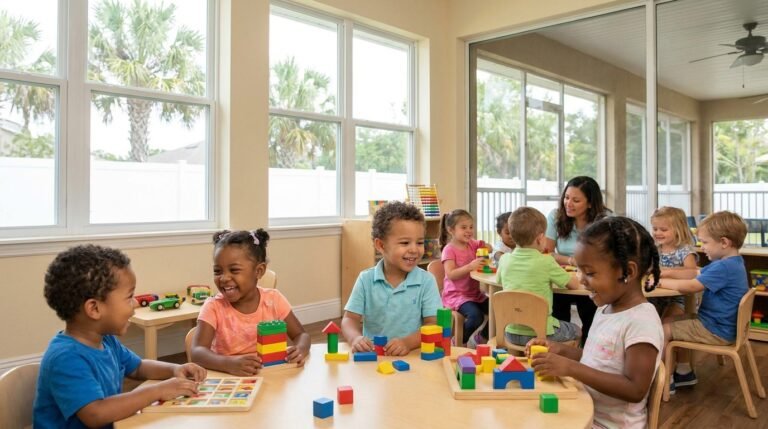
Traditional daycare centers are the most common choice for working parents in Florida. They’re typically open from 6 or 7 AM to 6 PM, serving children from 6 weeks through pre-K (and sometimes school-age kids in before/after care programs).
Pros
- Structured environment with age-appropriate classrooms
- Licensed and inspected by Florida DCF
- Consistent hours — reliable for working parents
- Socialization with peers
- Staff must meet training and background check requirements
Cons
- Higher cost, especially for infants ($250–$400/week in most Florida cities)
- Less flexibility — set hours, holiday closures
- Higher child-to-staff ratios than home-based care
- Your child will get sick more often initially (that’s normal and actually builds immunity)
Best for: Families with standard work schedules who want a structured, regulated environment.
Preschools
Preschools focus specifically on educational preparation for children ages 3-5. Many Florida preschools participate in the VPK (Voluntary Prekindergarten) program, which provides free pre-K education for all 4-year-olds in the state.
Pros
- Strong educational focus — curriculum designed for school readiness
- VPK programs are free (540 hours during school year)
- Teachers often have higher educational qualifications
- Great for developing social skills in a learning environment
Cons
- Often only half-day programs (though many offer wraparound care for an additional fee)
- Usually don’t accept infants or toddlers under 2-3 years
- May follow a school-year calendar with summer breaks
- VPK hours alone aren’t enough for most working parents
Best for: Families with 3-5 year olds who prioritize educational preparation and can handle the scheduling logistics.
Family Daycare Homes
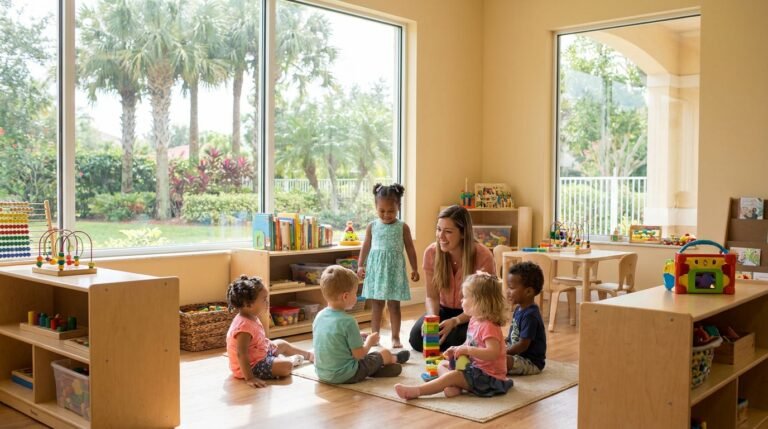
Family daycare homes operate out of the provider’s own residence. In Florida, a family daycare home can care for up to 5 children (not counting the provider’s own kids, with some limits). Large family childcare homes can serve 6-12 children with additional staff.
Pros
- Smaller group size — more individual attention
- Home-like atmosphere, which can be comforting especially for infants and toddlers
- Often more affordable than centers ($150–$280/week is common)
- More flexible scheduling in many cases
- Mixed-age groups can benefit children socially
Cons
- Less regulation than centers (though still licensed by DCF)
- If the provider is sick, you might not have backup care
- Fewer resources and equipment compared to larger centers
- Less oversight — fewer staff means less peer accountability
Best for: Families who want a smaller, more intimate setting, especially for infants and toddlers.
Nannies and Au Pairs
In-home care through a nanny or au pair gives you the most personalized childcare experience. The caregiver comes to your home (or lives with you, in the case of au pairs).
Pros
- One-on-one attention for your child
- Maximum flexibility in scheduling
- Your child stays in their own environment
- No exposure to other children’s illnesses
- Can handle multiple children in the same family
Cons
- Most expensive option — expect $500–$800/week or more for a full-time nanny in Florida
- You’re an employer with tax and legal obligations
- Less socialization with other children
- Not regulated by DCF (no inspections, no required training)
- If the nanny is sick, you have no backup
Best for: Families with higher budgets, multiple children, or non-standard schedules who want maximum flexibility and personalized care.
Faith-Based Programs
Many churches, synagogues, and mosques in Florida operate childcare programs. These programs are licensed by DCF like any other facility, but may also incorporate religious education or values into their curriculum.
Faith-based programs sometimes offer lower rates because they’re subsidized by the congregation. They’re often well-established in the community and have strong parent networks. If you’re comfortable with the religious component, these can be excellent options.
How to Decide: Questions to Ask Yourself
- How old is your child? Infants and young toddlers often thrive in smaller settings. Older preschoolers benefit from structured group environments.
- What’s your budget? Be realistic. Childcare is an investment, but it shouldn’t put you in financial distress.
- What are your work hours? Traditional centers work for 9-to-5 schedules. Shift workers or freelancers might need more flexibility.
- What matters most to you? Education? Socialization? Individual attention? Cultural or religious values?
- What’s available near you? In some Florida communities, options are limited. Use our directory to see what’s in your area.
The Bottom Line
There’s no single “best” type of childcare — only what’s best for your family right now. And it’s okay for that to change. Many families use different types of care as their children grow, their schedules shift, or their budgets change. The important thing is that your child is safe, cared for, and getting the stimulation they need to develop well.
Explore licensed daycare options across Florida in our complete directory, covering Miami, Orlando, Tampa, Fort Lauderdale, Jacksonville, and hundreds more cities.

Trusted Developer
Contributing writer covering Find Licensed Childcare Near You.